Record Keeping and Cost Analysis, Agri-crop
Importance of
Record Keeping
 Record
keeping is very important in any venture especially in agricultural enterprise. It provides substantial
information important in decision-making. Data gathered from farm records also
help in planning and budget preparation. It is a source of data in obtaining
credit, insurance, and in preparing tax returns and reports required by the
government. It is also useful in marketing farm produce and in other farming
activities. Farm records determine the value of the project. Agricultural
managers use them as collaterals in obtaining loans from banks and other
financing entities. Or if the owner wants to sell the farm, this could be used
as document in presenting the performance of the farm to would be buyers.
Record
keeping is very important in any venture especially in agricultural enterprise. It provides substantial
information important in decision-making. Data gathered from farm records also
help in planning and budget preparation. It is a source of data in obtaining
credit, insurance, and in preparing tax returns and reports required by the
government. It is also useful in marketing farm produce and in other farming
activities. Farm records determine the value of the project. Agricultural
managers use them as collaterals in obtaining loans from banks and other
financing entities. Or if the owner wants to sell the farm, this could be used
as document in presenting the performance of the farm to would be buyers.
To facilitate effective
record management, the following records can be kept.
1. Cash records. This is a record of the cash accounts in a
project. It can be seen in one record or this may be a special cash record
wherein the cash received journal and cash payments journal are separately
recorded transactions.
Sample
Combined Cash Record
|
Date
|
Cash Received
|
Cash Paid
|
||||
|
Amount
|
Receipt No.
|
Remarks
|
Amount
|
Receipt No.
|
Remarks
|
|
|
March
2, 2014
March
10, 2014
|
P8,000.00
P12,000.00
|
0913412
0877611
|
Sale
of 10 cavans of palay @ P800/cavan
Sale
of 12 cavans of milled rice @
P1,000.00 at 50kg/ sack
|
P4,400.00
P3,400.00
|
0112311
0887123
|
Payment
for 8 sacks of 14-14-14 fertilizers @ P550/bag (50k)
Payment
for 4 liters of pesticides
|
|
Total
|
P20,000.00
|
|
|
P7,800.00
|
|
|
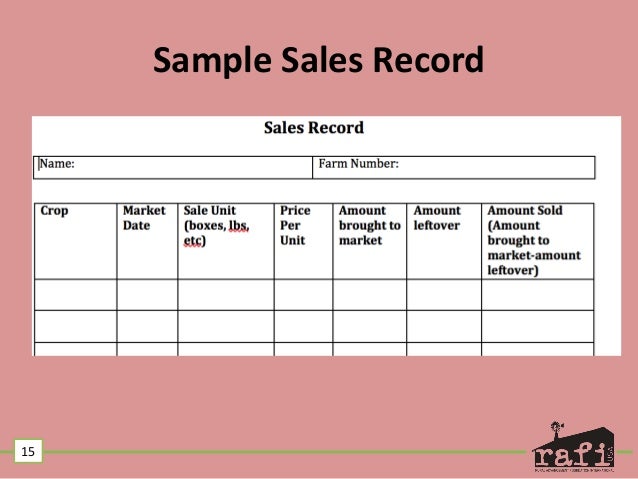
2. Farm sales record. This
is used to record all sales in rice production. There are two kinds of farm
sales record: general and the classified.
The general form has only
one amount column where the value of farm produce sold is recorded. The other
columns are for the other pertinent information such as date, unit,
description, and unit value.
|
Date
|
Description
|
Quantity
|
Unit
|
Unit Value
P
|
Total Value
P
|
|
March 2
March 3
|
rice
glutinous
|
50
5
|
cavans
cavans
|
P 800.00
1,000.00
|
P40,000.00
5,000.00
|
The classified farm sales
record contains special columns for the main product of the farm stock record.
3. Stock record. This record shows
the stock of supplies and materials needed by the farm for all farming activities,
especially in large-scale production.
Aside from the date item
columns, the stock record has three main columns the received column, the
issued column, and the balance column. The received column has three sub
columns: quantity, unit price, and the total amount of the materials received.
The issue column shows the quantity used while the balance column shows the
materials or supplies which are unused. The stock record is useful in
determining how much supplies and materials are needed per cropping .
Here is an example of
stock record.
|
Date
|
Item
|
Quantity
|
Unit Value
|
Total Value
|
Issued/Used Quantity
|
Balance Unused Quantity
|
|
Mar.
3
Mar.
8
|
Fertilizer
Herbicide
|
8
bags
2
bottles
|
P800/bag
P1,200/b
|
P6,400.00
P2,400.00
|
4
1
|
4
1
|
|
Cropping season
|
Description of the commodity
|
Cost of Production
|
Total Sales
|
Remaining stock
|
Net Income
|
|
January to April
|
Pepper
|
P3,500.00
|
P10,500.00
|
500 grams
|
P7,000.00
|
|
May to October
|
Rice
|
P5,000.00
|
P22,000.00
|
250 grams
|
P17,000.00
|
|
November to December
|
Beans
|
P2,000.00
|
P8,000.00
|
90 grams
|
P6,000.00
|
|
|
Total
|
P10,500.00
|
P40,500.00
|
|
P30,000.00
|
From the sample above, it
may be noted that the total annual income of the farm for that year gained
P30,000.00. However, the amount does not include its remaining stocks.
The following table shows a sample
cost and return analysis in rice production for one-hectare lowland and
irrigated rice.
Method of
planting: Transplanting (Wet Season)
Variety: HYV
Seeds : 2 bags certified seeds at P1,200.00/sack
Soil condition :
High/Medium NPK (Soil Test Results)( RR= 68-28-45)
|
Item
|
Labor
Cost of Man/Day (8 hrs) P
|
Labor
Cost of Man & Animal /Day (8hrs)
|
No.
of Days Req. at 8 hrs./day
|
Amount
|
|
1.Land
Preparation
Seed and seedbed preparation
Wetbed
Plowing
Harrowing and
Leveling
Repair and Dike
Cleaning
Sub total
|
P200
P200
|
P300
P300
P300
|
2
.5
10
8
4 persons
|
P 400.00
P 150.00
P3,000.00
P2,400.00
800.00
P6,750.00
|
|
2. Crop Management
Sowing and Care
of seedlings
Pulling and bundling seedlings
Transplanting
Weeding (Manual)
Irrigation
Application of herbicides
Application of insecticides
Application of Fertilizers
(Basal and Side dressing
|
P200
P200
P200
P200
P200
P200
P200
|
|
2
persons
4 persons
15 persons
5 persons
1 person
4
persons
4
persons
|
P 400.00
P 800.00
P3,000.00
P1,000.00
200.00
800.00
800.00
|
|
Sub total
|
|
|
|
P7,000.00
|
|
3. Other Major Operations
Harvesting,
threshing, winnowing, and hauling
(contractual basis)
Drying and hauling
|
contract
7
cavan/ha
@5/cavan
@5/cavan
|
|
4,500/ha
@ P14.00/kg
@
110 cavans/ha
|
P4,500.00
4,900.00.
550.00
550.00
|
|
Sub total
|
|
|
|
P10,500.00
|
|
Agricultural Inputs
Herbicides Machete
Insecticides Karate
Cymbush
Fertilizers
|
1
liter @ P680.00
1
liter @ P1,020/liter
0.5
liter @ P850/liter
4
bags T14 @ P1,100.00/b
87 kgs. 46-0-0 @
P1,000/bag (1 bag= 50kg.)
28 kgs. 0-0-60 @ P750/bag
|
|
|
P 680.00
P1,020.00
425.00
4,400.00
1,740.50
420.00
|
|
Sub total
|
|
|
|
P8,685.50
|
Assumption: Average yield per hectare
= 5.5 metric tons or 110 cavans. Price of palay
is estimated at P14.00 per kilogram
Total expenses =
P35,335.00
Total Income =
P77,000.00
Net Income =
P41,665.00
ROI (return of
investment) = 117.91%
(Net income/total cost of production
x 100)