Bloom et al.'s Taxonomy of the Cognitive Domain
 |
| Blooms
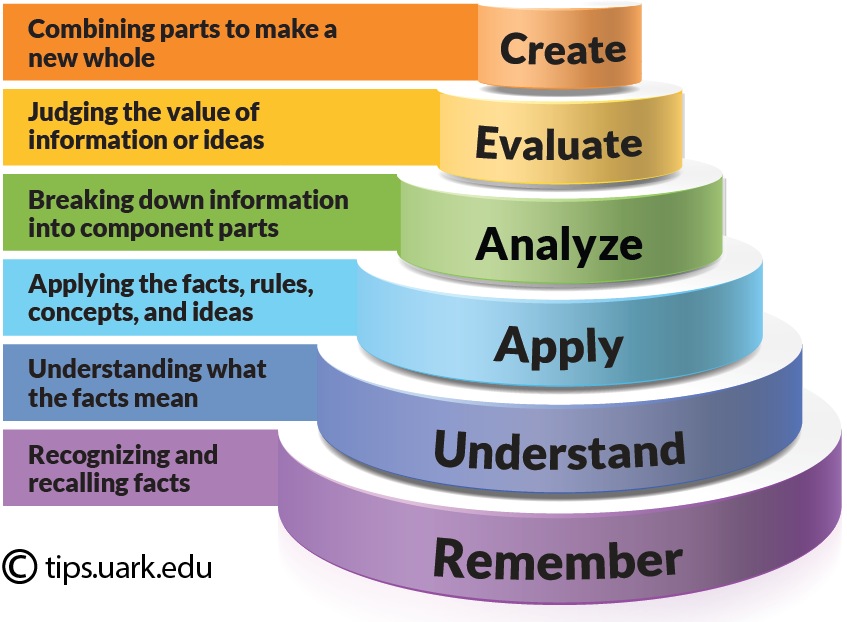
Bloom’s Taxonomy is a classification of the different objectives and skills that educators set for their students (learning objectives). The taxonomy was proposed in 1956 by Benjamin Bloom, an educational psychologist at the University of Chicago. The terminology has been recently updated to include the following six levels of learning. These 6 levels can be used to structure the learning objectives, lessons, and assessments of your course. :
Remembering: Retrieving, recognizing, and recalling relevant knowledge from long‐term memory.
Understanding: Constructing meaning from oral, written, and graphic messages through interpreting, exemplifying, classifying, summarizing, inferring, comparing, and explaining.
Applying: Carrying out or using a procedure for executing, or implementing.
Analyzing: Breaking material into constituent parts, determining how the parts relate to one another and to an overall structure or purpose through differentiating, organizing, and attributing.
Evaluating: Making judgments based on criteria and standards through checking and critiquing.
Creating: Putting elements together to form a coherent or functional whole; reorganizing elements into a new pattern or structure through generating, planning, or producing.
Bloom’s taxonomy is a powerful tool to help develop learning objectives because it explains the process of learning:
Before you can understand a concept, you must remember it.
To apply a concept you must first understand it.
In order to evaluate a process, you must have analyzed it.
To create an accurate conclusion, you must have completed a thorough evaluation.
However, we don’t always start with lower order skills and step all the way through the entire taxonomy for each concept you present in your course. That approach would become tedious–for both you and your students! Instead, start by considering the level of learners in your course:
Are lots of your students freshman? Is this an “Introduction to…” course? If so, many your learning objectives may target the lower order Bloom’s skills, because your students are building foundational knowledge. However, even in this situation we would strive to move a few of your objectives into the applying and analyzing level, but getting too far up in the taxonomy could create frustration and unachievable goals.
Are most of your students juniors and seniors? Graduate students? Do your students have a solid foundation in much of the terminology and processes you will be working on your course? If so, then you should not have many remembering and understanding level objectives. You may need a few, for any radically new concepts specific to your course. However, these advanced students should be able to master higher-order learning objectives. Too many lower level objectives might cause boredom or apathy.
How Bloom’s works with learning objectives
Fortunately, there are “verb tables” to help identify which action verbs align with each level in Bloom’s Taxonomy.
You may notice that some of these verbs on the table are associated with multiple Bloom’s Taxonomy levels. These “multilevel-verbs” are actions that could apply to different activities. For example, you could have an objective that states “At the end of this lesson, students will be able to explain the difference between H2O and OH-.” This would be an understanding level objective. However, if you wanted the students to be able to “…explain the shift in the chemical structure of water throughout its various phases.” This would be an analyzing level verb.
|