Other Pest, Agri-crop

Golden snail is one of the delicacies enjoyed by farmers
before. Now it is a recognized rice pest. It produces numerous pinkish egg
masses visibly seen on levees which
usually hatch from 9 to 12 days. This pest is destructive during the early
growth stage of rice plants 14 days from sowing to 20 days after transplanting.
The pest
feeds on the vegetative parts of young rice plants and could wipe out plants in
a given area overnight.
Population of golden apple snail can be prevented by the
following:
- Handpick the golden snails and use these as animal feed.
- Observe cleanliness and sanitation.
- If cultural management is not feasible use molluscicide to control
them. Drain water before spraying and always wear protective gear when
using chemicals.
Rat Control
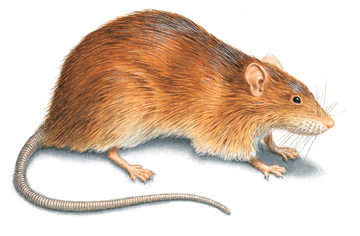 Rats have
been a persistent problem of rice growers, especially in areas near forests and uncultivated lands. They cause estimated yields losses ranging from 5-60%. Rats
attack at all stages of rice growth but reach their peak during the maturity
stage. Damage is greater during wet season. To control rats effectively, keep
the rice fields clean and employ sustained baiting only when necessary. Make
use of available rodenticides in the
agricultural supply and always follow the manufacturer’s instruction in its
label.
Rats have
been a persistent problem of rice growers, especially in areas near forests and uncultivated lands. They cause estimated yields losses ranging from 5-60%. Rats
attack at all stages of rice growth but reach their peak during the maturity
stage. Damage is greater during wet season. To control rats effectively, keep
the rice fields clean and employ sustained baiting only when necessary. Make
use of available rodenticides in the
agricultural supply and always follow the manufacturer’s instruction in its
label.
Diseases and their Control
The most practical way to prevent
the occurrence of diseases is to plant resistant varieties, practice good
cultural management starting from the land preparation, and always remember to
have at least 30 days planting breaks.
Viral
Diseases
- Tungro. The most
destructive among virus diseases, this usually occurs in a lowland ricefield. It
is caused by virus which is transmitted from a diseased plant to a healthy
one through the feeding activity by three leafhopper species: Nephotettix
virescens, N. nigropictus and Resilia dosalis. Nephotettix virescens is
the most destructive vector. Tungro occurs from seedling to booting stages
(Figure 12). It is prevalent in the whole country except inBatanes during
the wet season from July to November. Figure 13 presents the transmission
cycle of rice tungro.
- Yellow dwarf. The disease usually occurs
sporadically in fields. Infection often takes place during the late stages
of plant growth. The virus is transmitted by three species of leafhoppers:
Nephotettix cincticeps, N. nigropictus and N. malayanus. Most leafhoppers
acquire the virus by feeding on diseased plants for 1-3 hours. About half
the infective individuals of the species can infect healthy plants within
1 hour feeding. Yellow dwarf is prevalent from seeding to booting stages.
- Grassy stunt. This is prevalent in farms
employing an overlapping rice cropping system. The virus may survive in
the harvested rice stubbles. Generally, the disease is less severe when
older plants are infected. The virus is transmitted from infected plants
to healthy ones by the brown planthopper. The disease usually infects the
rice plant during the seedling to booting stages.
Bacterial
Diseases
- Bacterial leaf blight. (Xanthomonas campestris). It is
widespread in the country especially in areas with high rainfall and
humidity. Infection starts at the tip of leaf margins and may cover the
entire leaf blade. The bacterium enters the leaf through cuts or wounds
and on the natural openings of the leaf. The systematic form of the
disease called “kresek” usually occurs at seedling stage up to the dough
stage. The form of the disease is known as “blight.” This is prevalent
especially after typhoons.
- Bacterial leaf streak. (Xanthomonas campestris pv. Oryziccola).
This disease does not reduce yield if low rates of nitrogen are applied
although it may lower yields of susceptible varieties. The disease may
spread throughout the entire rice field by the action of rain and wind. It
attacks the rice plant from tillering to dough stages. The disease is
prevalent after typhoons.
Fungal
Diseases
- Rice blast. (Pyricularia oryzae). This is the
most common disease of rice infecting plants at any stage of growth.
Symptoms are most conspicuous on the leaves (leaf blast), nodes (nodal
blast) and parts of the panicles (neck rot), and grain. The neck of the
panicles becomes most vulnerable to attack during early emergence of the
panicle. Lesions form at the neck causing the panicles to fall over.
The disease development and severity is aggravated by high amount of quick acting fertilizers such as ammonium sulfate, cloudy skies with frequent rains and drizzle, and a relative humidity of 90% and above usually common during the months of November to February. - Cercospora leafspot (Sphaerulina oryzina Hara). The long
axis of this spot is parallel with the veins of the leaf. This disease is
also known as narrow brown spot. It seldom infects seedlings or grains. In
susceptible varieties, the spot may be slightly wider in light, narrow
centers. It causes harm by reducing the effective leaf area of the plant.
The disease is favored by low nitrogen level in the soil.
- Brown spot or Helminthosporium leaf spot (Helminthosporium
oryzae). This disease is probably present in all rice producing areas.
It infects all stages of a rice
plant. It is common in nutrient deficient soil and soils containing a
large proportion of sand or peat.
- Stem rot (Helminthosporium sigmoidium).
Infection of the disease occurs near the water line usually at the maximum
tillering stage up to the milk stage. Severely infected plants produce
poor quality grains that are light and chalky.
- Sheath blight (Rhizoctonia solani). The disease
occurs during the heading stage to the milk stage. Sheath blight is
destructive under highly humid and warm temperature and in areas where
close planting and heavy fertilization are practiced.
- Sheath rot (Sanocladium oryzae Sawada). The
fungus is seedborne and infection takes place through the stomata and
wounds. It attacks the leaf sheath enclosing young panicles when there is
an injury which retards the emergence of the panicles. An abundant whitish
powder growth may be found inside the infected sheath and the young
panicle rot. The disease incidence is common with stemborer, planthopper
and mite damage, and application of
high nitrogen.
IMPORTANT
THINGS TO REMEMBER
- Methods of controlling pest and diseases
- Cultural method
- Proper land preparation
- Plant at the same time with your neighboring farmers
- Clean culture
- Chemical method. Always read labels before use
- Biological method
- Introduction of friendly insects to suppress pests and diseases
- With the help of predators such as birds, snakes
- Use of resistant varieties
- Always be familiar with Insect pests/diseases, nature of attack and
control measures
- The safety measures in handling chemical are the following:
- Store pesticides locked and out of reach of children
- Wear gloves when mixing pesticides
- Wear mask to prevent inhalation of pesticides. Always wash hands
with soap after spraying
- Do not smoke or eat when using pesticides
- Consider the IPM to avoid wastage brought by unnecessary spraying of
pesticides
- Use varieties
resistant to pests prevalent in the locality. The use of resistant
varieties is the first line of defense in pest management and is
compatible with biological control. Change or rotate varieties every 2 - 4
cropping to disrupt insect pest and disease adaptation, thereby preventing
build up of virulent pathogens and insect pests.
- Adopt a
synchronous planting scheme after a fallow period in the locality.
- Conserve
beneficial organisms. There are rich communities of beneficial organisms
in the rice ecosystem in the absence of natural-enemy killing pesticides.
The indiscriminate use of pesticides reduces biodiversity and disrupts the
natural balance of insect pests and beneficial organisms. Conservation of
these beneficial organisms is safe, economical, and permanent. For
example, long-horned grasshopper feeds on the egg mass of stem borers
while spiders feed on the nymphs and adults of leafhoppers and plant
hoppers.
- Weeds are destructive, they reduce rice yield by competing for
sunlight, moisture, and soil nutrients.
- Three types of weeds are grasses, sedges,
- . and broadleaves.
- The methods of controlling weeds are:
a.
Preventive method
b.
Physical/mechanical method
c.
Cultural method
d.
Chemical method
- Pointers for effective use of herbicide:
a.
Apply at the right time
b.
Use the right dosage
c.
Spray during fair weather
d. Distribute
spray solution accurately
Eradicate – to wipe out
Weeds - plants that grow in places where they are not wanted
Grasses - weeds which have long narrow,
two-ranked usually flat
leaves
with parallel veins and round stem
Sedges - similar to grasses but of
three-ranked leaves, and
with triangular solid
stems
Broad-leaved weeds - dicotyledonous
plants with broadleaves
Herbicides - chemical used to control
and kill weeds
Insect pests - insects that are harmful
to plants
Rodents – rats
Diseases – impairments on the normal
health of the plant
Insecticides - chemicals used to
control insects
Fungicides - chemicals used to control
fungus
Molluscicide - chemical used to control
golden snails
Lesion - a well-marked but limited
diseased area on the plants
Nocturnal insect - insect that feeds on
plants during night time
Dead heart - dried youngest leaf of the
plant during tillering stage
White head – dried, unfilled white
panicle during heading stage
Symptoms - observable characteristics of a diseased plant
PPE - personal protective equipment