Care and Management Practices for Quail
Management practices which include the management of housing, brooding, feeding and sanitary measures in the farm to prevent the spread of diseases should be observed in the farm to insure maximum production and profit.
Housing
Quails are easier to raise than chicken. Providing housing and fixtures are not as difficult as that of chicken. Locally available materials such as bamboo and used lumber or galvanized iron can be used to construct the house and fixtures for quail. the flooring and sides of the cage can be of bamboo splits nailed with a distance of 1/2 inch. a plastic mesh or welded wire can be used in all sides of the cage to protect the birds from rats. A 4 feet x 8ft. x 1 foot high cage is recommended for 250-300 layers.
Incubation
Native quail or pugo hatch their own eggs. for imported breeds they do not brood to incubate their eggs, therefore, an incubator must be be used.
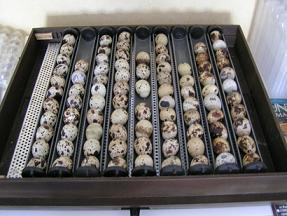
How to operate an electric table-top incubator/ hatcher for quail.
In order to get a higher hatching efficiency, the incubator should be properly operated.

Housing
Quails are easier to raise than chicken. Providing housing and fixtures are not as difficult as that of chicken. Locally available materials such as bamboo and used lumber or galvanized iron can be used to construct the house and fixtures for quail. the flooring and sides of the cage can be of bamboo splits nailed with a distance of 1/2 inch. a plastic mesh or welded wire can be used in all sides of the cage to protect the birds from rats. A 4 feet x 8ft. x 1 foot high cage is recommended for 250-300 layers.
Incubation
Native quail or pugo hatch their own eggs. for imported breeds they do not brood to incubate their eggs, therefore, an incubator must be be used.
How to operate an electric table-top incubator/ hatcher for quail.
In order to get a higher hatching efficiency, the incubator should be properly operated.
- Check wire connections of the incubator. Check also electric voltage [220v] before plugging the incubator.
- Run the incubator for two days or until desired temperature [1000 to 1030oF] is maintained.
- Arrange the eggs in the egg tray. Do not load the tray tightly as eggs may be broken when turning.
- Check the water pans under the trays for humidity control before placing the trays eggs.
- Place a reminder chart on the activities to carry out during incubation.
- Turn the eggs three times a day by passing the hands lightly over the eggs.
- Candle on the 11th day.
- Expect hatching on the 16th to 18th day.
- Stop turning the eggs three days before hatching. On hatching day, when the chicks are out of the shells, the air vent on top of the incubator should be fully opened to allow ventilation and facilitates drying out of feathers.