Art of Ancient Egypt
The first great civilizations emerged about 3000 B. C. in Egypt, China, India, and Mesopotamia.
Ancient Egyptian Culture
Ancient Egypt developed along the fertile banks of the Nile.
The Nile played an important role in Egyptian life. With its annual floods, the river enriched the soil, making the land excellent for farming. Later, after Egyptian civilization had prospered and grown, the river provided transportation routes.
Egypt was ruled by a leader called pharaoh. The pharaoh was more than just a king in the eyes of the Egyptian people.
Architecture
The belief in an afterlife was an important feature in Egyptian religion and art. It inspired one of Egypt's greatest achievements in art- the great pyramids.

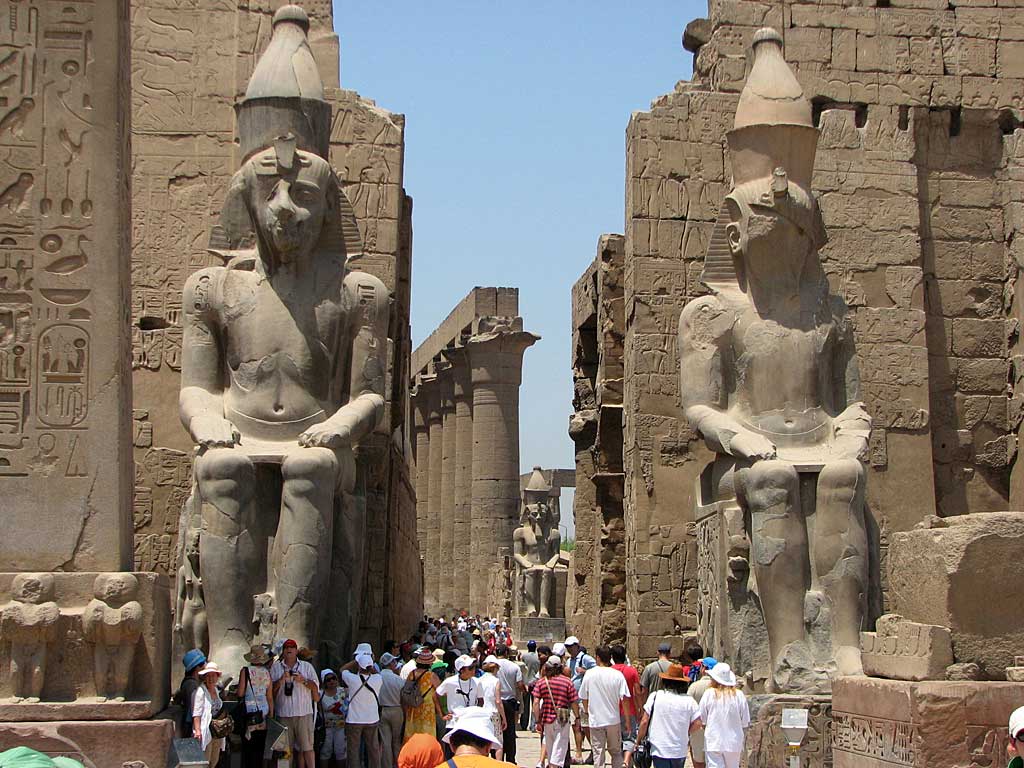
These architectural wonders are the oldest stone buildings in the world. Intended as tombs for the pharaohs, the pyramids were constructed by thousands and thousands of workers. these people toiled for decades to build a single pyramid. The biggest ever built rises higher than a 40- storey building. It covers an area greater than that of ten football fields. Today, more than 80 pyramids still exist.
Sculpture
The Egyptians believed that the body had to be preserved after death: that way, the person's spirit, or Ica, would have body to live in during the next life. As a kind of insurance, sculpture of the dead were place in tombs. These were meant as substitutes for the body. even if the real body were destroyed, the Ica would have a substitute body to live in for all eternity.


Painting
Every example of Egyptian art strictly adheres to a code or a set of rules for producing the artwork. The style is called frontalism. In paintings, frontalism means that the head of the character is always drawn in profile, while the body is seen from front. Although the face is to the side, the eyes is drawn in full. The legs are turned to the same side as the head, with one foot in placed in front of the other. The head is at right angles to the body.


Ancient Egyptian Culture
Ancient Egypt developed along the fertile banks of the Nile.
The Nile played an important role in Egyptian life. With its annual floods, the river enriched the soil, making the land excellent for farming. Later, after Egyptian civilization had prospered and grown, the river provided transportation routes.
Egypt was ruled by a leader called pharaoh. The pharaoh was more than just a king in the eyes of the Egyptian people.
Architecture
The belief in an afterlife was an important feature in Egyptian religion and art. It inspired one of Egypt's greatest achievements in art- the great pyramids.
These architectural wonders are the oldest stone buildings in the world. Intended as tombs for the pharaohs, the pyramids were constructed by thousands and thousands of workers. these people toiled for decades to build a single pyramid. The biggest ever built rises higher than a 40- storey building. It covers an area greater than that of ten football fields. Today, more than 80 pyramids still exist.
Sculpture
The Egyptians believed that the body had to be preserved after death: that way, the person's spirit, or Ica, would have body to live in during the next life. As a kind of insurance, sculpture of the dead were place in tombs. These were meant as substitutes for the body. even if the real body were destroyed, the Ica would have a substitute body to live in for all eternity.
Painting
Every example of Egyptian art strictly adheres to a code or a set of rules for producing the artwork. The style is called frontalism. In paintings, frontalism means that the head of the character is always drawn in profile, while the body is seen from front. Although the face is to the side, the eyes is drawn in full. The legs are turned to the same side as the head, with one foot in placed in front of the other. The head is at right angles to the body.
We are giving FREE Selling and Business Consultation; please
click the link below,
We prepare Speech and Messages; please click the link below,